Cybersecurity and UPSC: Different Paths, Similar Discipline
A personal perspective on how cybersecurity, much like UPSC preparation, demands discipline, continuous learning, and long-term commitment — and how protecting digital infrastructure has become a modern form of national service in an increasingly connected India.
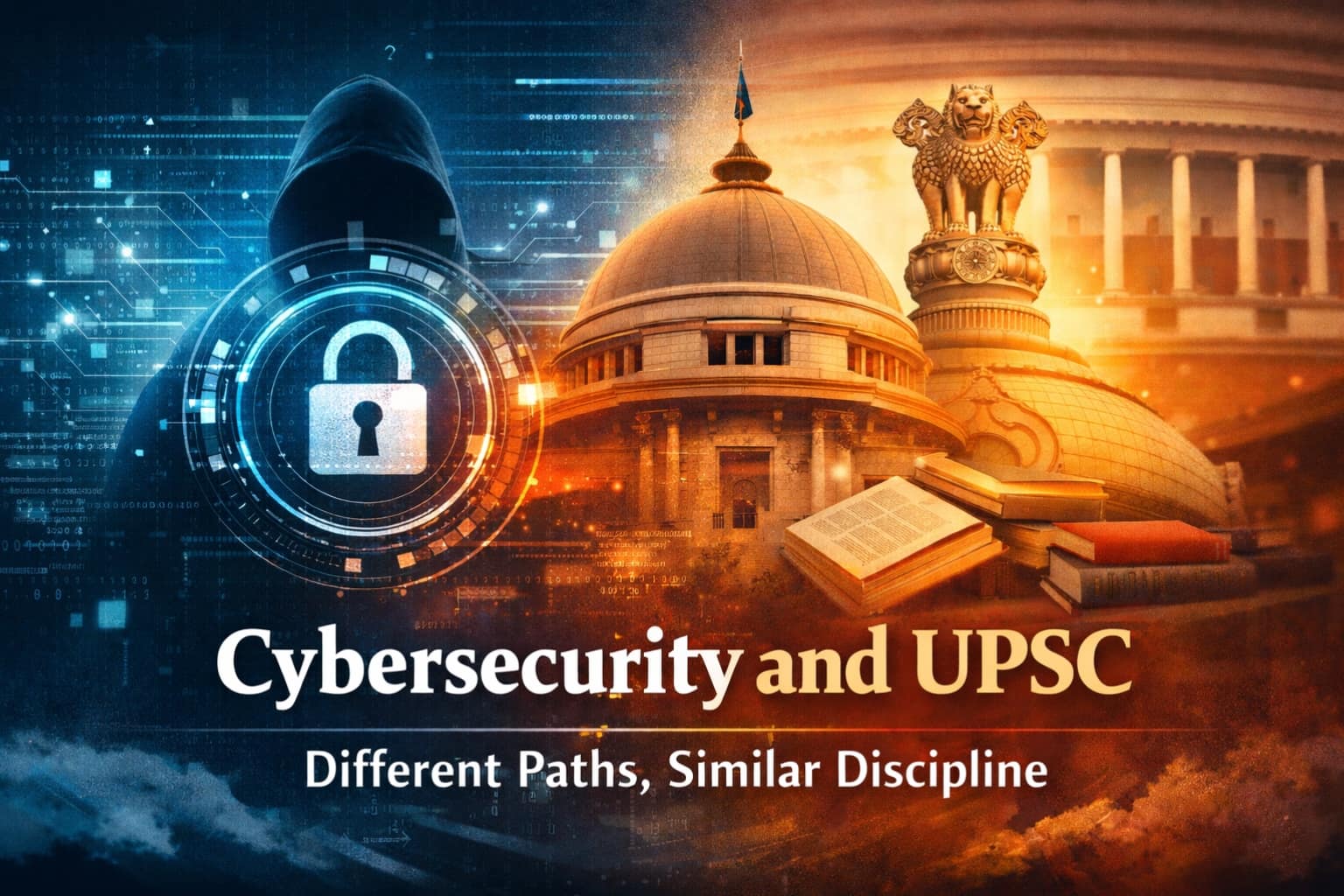
In India, serving the nation is often associated with clearing UPSC and entering civil services. I used to think the same. But as I spent more time in cybersecurity - understanding how digital systems fail and how easily they can be exploited - my perspective slowly began to change. Today, when banking systems, government services, and citizen data increasingly exist online, protecting digital infrastructure feels just as critical as administering physical systems. From my experience, cybersecurity has evolved into a modern form of national service, one that demands equal levels of responsibility, continuous learning, and discipline.
“Why I started comparing the complexity of cybersecurity with UPSC preparation itself.”
What made me draw this comparison was not the title or prestige associated with either path, but the nature of preparation itself. UPSC preparation is known for its vast syllabus, requiring aspirants to understand and connect multiple subjects in depth over long periods of time. In cybersecurity, I began experiencing a similar challenge - except there was no defined syllabus or finishing point. Every new technology introduced new risks, every vulnerability demanded deeper understanding, and staying relevant required constant learning. Over time, I realized that the complexity in cybersecurity does not come from memorizing information, but from continuously adapting to an ever-changing landscape.
“Serving the Nation: Physical Governance vs Digital Defense (My Perspective)”
Growing up, I always associated serving the nation with visible roles - administration, governance, law enforcement, and policy-making. The impact was clear and direct. Civil servants work on ground-level problems, make decisions that affect millions, and play a crucial role in shaping how systems function.
My understanding began to change when I started working more deeply in cybersecurity. I realized that a significant part of our country now operates in digital space. Banking transactions, government services, healthcare records, education platforms, and even daily communication depend on systems that most people never see but rely on completely.
When these systems are vulnerable, the consequences are not just technical. A breach can affect citizens financially, compromise privacy, or disrupt essential services. Reporting a vulnerability or preventing an attack may not be visible to the public, but the impact is real. Over time, I began to see cybersecurity as a form of protecting the nation’s digital infrastructure - not very different in intent from protecting physical systems, but executed in a different domain.
For me, this realization changed cybersecurity from being just a technical career into a responsibility. The work may happen behind screens, but the people it protects are real.
“The Complexity: Why Cybersecurity Feels Like an Endless Syllabus”
One thing I have always respected about UPSC preparation is the ability to handle an enormous syllabus. Aspirants spend years understanding history, polity, economics, geography, ethics, and current affairs — not just individually, but as interconnected subjects. The challenge is not only remembering information, but developing the ability to think across domains.
In cybersecurity, I began experiencing a similar kind of intellectual demand, but with one major difference — there is no fixed syllabus. The moment I feel comfortable with one area, a new technology, framework, or attack technique emerges that changes the landscape again. Something considered secure yesterday may become vulnerable tomorrow.
My learning slowly expanded beyond just tools or techniques. I had to understand networking fundamentals, operating systems, programming logic, cloud infrastructure, web architectures, and even human behavior in the context of social engineering. The challenge was never about finishing a topic, but about continuously adapting and connecting knowledge across multiple layers of technology.
Over time, I realized that cybersecurity is less about reaching mastery and more about staying in a constant state of learning. That ongoing complexity is what made me relate it to the depth and discipline required in UPSC preparation — except in cybersecurity, the syllabus keeps rewriting itself.
“Understanding Over Memorization: Why Cybersecurity Demands a Different Kind of Thinking”
One of the biggest differences I noticed while growing in cybersecurity was that memorization alone has very little value. Remembering commands, tools, or payloads does not make someone effective at either attacking or defending systems. What matters more is understanding why systems behave the way they do and where assumptions break.
In my experience, vulnerabilities rarely exist because someone forgot a rule. They exist because of misunderstood logic, misplaced trust, or small design decisions that create unexpected consequences. Finding or preventing these issues requires thinking from an attacker’s perspective — questioning how inputs are handled, how permissions are enforced, and how different components interact with each other.
This gradually changed how I approached problem-solving. Instead of looking for predefined answers, I started looking for patterns, weaknesses, and unintended behaviors. Cybersecurity, in that sense, becomes less about remembering information and more about developing analytical thinking and curiosity.
That mindset reminded me of the analytical depth required in civil services preparation, where understanding connections matters more than isolated facts. The difference is that in cybersecurity, the system itself keeps evolving, forcing you to continuously rethink what you already know.
“Responsibility and Pressure: When Mistakes Have Real Consequences”
One misconception I initially had about cybersecurity was that it was purely technical work — something limited to code, tools, and systems. Over time, I realized that the responsibility attached to this work is much larger than it appears from the outside.
A single vulnerability can expose sensitive data, disrupt services, or cause financial damage affecting thousands or even millions of users. During security assessments or vulnerability research, the realization that a small oversight could lead to large consequences changes how seriously you approach the work. There is very little room for assumptions.
Unlike exams or structured preparation, cybersecurity decisions often happen in real time. Incidents do not wait for perfect information. Sometimes you have to analyze incomplete data, make quick judgments, and act responsibly because delays themselves can increase risk.
This level of responsibility made me see cybersecurity differently. It stopped feeling like just solving technical problems and started feeling closer to protecting systems that people depend on daily. In that sense, the pressure is not very different from roles where decisions directly affect public systems — the difference is simply that the environment is digital.
“India’s Digital Growth and Why Cybersecurity Is Becoming a Modern Form of National Service.”
Over the last few years, I have watched India rapidly transition into a digital-first ecosystem. Payments, governance, education, healthcare, and communication have increasingly moved online. Systems that once operated physically are now dependent on software, cloud infrastructure, and interconnected networks.
With this growth comes a new kind of risk. The attack surface expands as more services become digital, and the consequences of insecurity grow proportionally. A vulnerability is no longer limited to a single application — it can affect financial systems, public services, or the privacy of millions of citizens.
From my perspective, this shift changes how we define national service. Alongside administrators who manage policies and systems, there is an increasing need for people who secure the technology those systems rely on. Cybersecurity professionals often work quietly, without visibility, but their role contributes directly to trust in digital infrastructure.
The more I worked in this field, the more I realized that cybersecurity is not only about protecting organizations. At scale, it becomes about protecting the digital confidence of a nation — ensuring that people can rely on the systems they use every day without fear of compromise.
Why Cybersecurity Matches UPSC in Complexity, Learning, and Commitment
One of the reasons I began comparing cybersecurity with UPSC was not because the roles are similar, but because the journey toward competence in both fields demands a similar mindset. From my experience, cybersecurity is not something that can be mastered quickly. It requires time, patience, and the willingness to stay consistent even when progress feels slow.
UPSC preparation is known for its vastness. Aspirants spend years building foundations, revisiting concepts, and learning to connect information across subjects. Cybersecurity follows a comparable pattern. Before reaching advanced areas, I had to spend long periods understanding fundamentals — networking, operating systems, programming, system architecture, and security principles. Skipping fundamentals almost always leads to gaps later.
Another similarity I noticed is the uncertainty involved. In UPSC, results are not guaranteed despite effort, and success depends on sustained discipline over long periods. Cybersecurity careers evolve in a similar way. Skills compound slowly. Many concepts only make sense after repeated exposure, failures, and practical experience. There are phases where learning feels overwhelming, and progress is not immediately visible.
Patience and perseverance become essential. Whether it is preparing for certifications, researching vulnerabilities, or understanding complex attack chains, growth in cybersecurity comes from consistency rather than short bursts of effort. The field rewards those who stay curious and persistent over time.
Career-wise as well, cybersecurity demands continuous reinvention. Technologies change, threats evolve, and professionals must keep learning to remain relevant. In that sense, the journey does not end after entering the field — learning becomes a permanent part of the career itself.
This is why, from my perspective, cybersecurity requires the same level of discipline, long-term commitment, and mental endurance that people often associate with UPSC preparation. The domains are different, but the effort required to reach meaningful competence feels remarkably similar.
Final Words
For me, cybersecurity and UPSC are not competing paths, nor are they meant to be compared in terms of importance. They represent different ways of contributing to the same goal — strengthening the nation in the domains that matter today. One works through governance and administration, while the other works through securing the digital systems that modern governance depends on.
My journey in cybersecurity made me realize that serving the nation is no longer limited to traditional roles. In an increasingly digital world, protecting systems, data, and infrastructure has become equally critical. The responsibilities may be less visible, but the impact is real.
I chose cybersecurity because it aligned with how I wanted to contribute — by understanding systems deeply, reducing risk, and helping build safer digital environments. And as India continues to grow digitally, I believe this form of service will only become more important in the years ahead.
Enjoyed this report?
If it helped, like it and pass it on to someone who needs it.
 cybersecurityFeatured
Cybersecurity Before Code: How Vibe-Coding Helped Me Build Real Full-Stack Systems
How a cybersecurity-first mindset and vibe-coding helped me build real full-stack systems—without mastering web development first.
 cybersecurityFeatured
Starting Cybersecurity in 2026: The Roadmap I Wish I Had When I Began
This is Part 3 of my cybersecurity journey — the roadmap I wish I had before confusion, burnout, and hard-earned clarity shaped how I learn and grow.
 cybersecurityFeatured
Linux for Cybersecurity Interviews: Commands, Concepts, and Real-World Scenarios Every Engineer Must Know
Linux is a baseline skill in cybersecurity interviews, not an optional one. This guide breaks down the exact Linux commands, concepts, and real-world security scenarios interviewers test across pentesting, SOC, and blue team roles. Learn how to think, investigate, and explain Linux behavior the way interviewers expect, with practical examples you can apply directly in interviews and real environments.